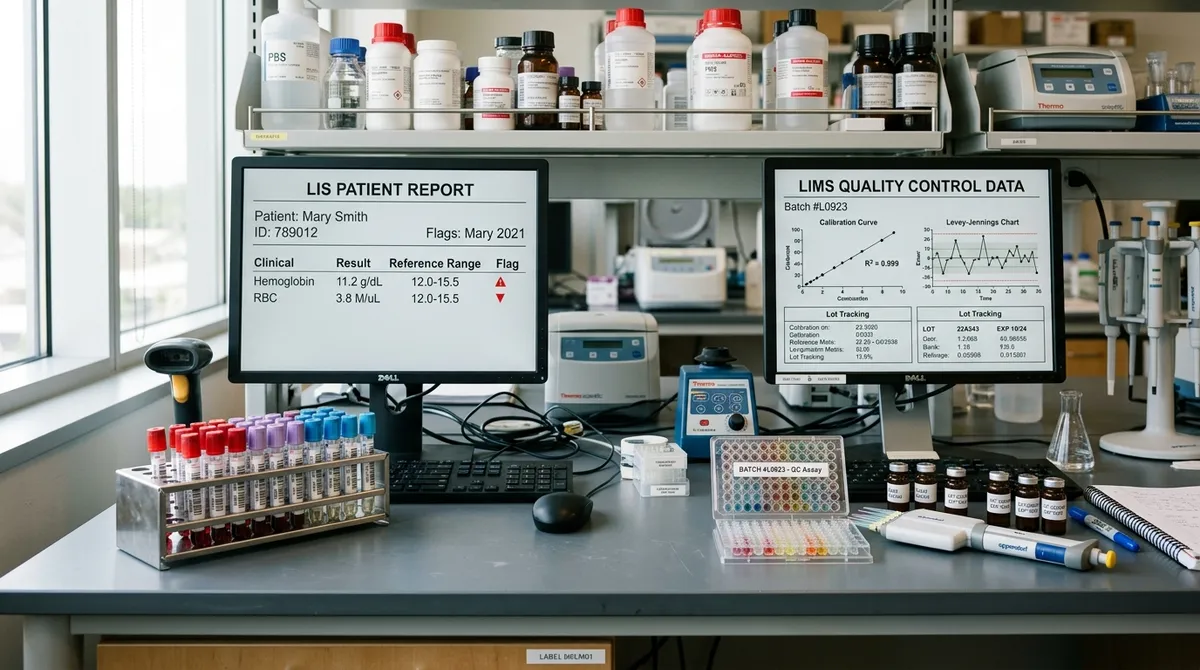
Ask around a lab management conference and you'll notice something: half the room uses "LIS" and "LIMS" like they're the same word, and the other half will insist they're worlds apart. Both groups are a little bit right, which is exactly why the confusion sticks around.
Vendors don't help. If a company sells a LIMS, that's what gets pitched — whether or not it's what your lab actually needs. You usually find out the mismatch six months in, right around when staff start complaining about a workflow that doesn't fit how they work.
So here's the difference, without the sales deck: an LIS is built around the patient. A LIMS is built around the sample. Once that clicks, most of the confusion falls away.
#WHY THIS MATTERS
You'll often hear that "70% of medical decisions depend on lab results." Treat that number with some suspicion — several peer-reviewed reviews have traced it back to an unsourced 1996 estimate, not any actual study, and it keeps getting recycled anyway.
#What's better documented
A real share of laboratory errors don't happen during testing at all. They happen afterward, when someone manually re-types a result from one system into another. Post-analytical errors like this account for 18–47% of the total, depending on the study. That's the actual case for better software — not vague productivity gains, but fewer chances for a transcription slip to become a wrong result on someone's chart.
#THE QUICK ANSWER
Patients walk in, results go to a doctor? You want an LIS. You're processing batches — research, food, water, environmental testing? You want a LIMS.
Everything below is for the cases that don't fit neatly into either bucket, and there are more of those than you'd think.
#What each one is actually for
An LIS answers questions about one person at a time — age, reference ranges, whether a result is dangerous enough to call someone right now. It plugs into hospital records so the moment a result is signed off, the ordering doctor can act on it.
A LIMS doesn't care about a patient's name, because there usually isn't one. Running heavy-metal screens on two hundred soil samples, the questions are different: where did this batch come from, who handled it, did the reagent expire last Tuesday. Instead of a result going to a doctor, a LIMS produces a Certificate of Analysis — proof a batch met spec before it shipped.
Worth flagging: running any of these well now asks more of you than the classic bench-scientist résumé — SQL or scripting for reports, API integration with instruments, some working knowledge of GMP or 21 CFR Part 11. If you're in that last row, this is the gap something like Consolish LIS is built for: one cloud-based, multi-tenant subscription running several sites instead of a server and a spreadsheet habit at each one.
#CONCLUSION
Diagnosing people — get an LIS. Analysing products, soil, water, or research samples — get a LIMS. Doing real volumes of both, don't buy two systems and hope they talk to each other later; look at a hybrid platform from the start.
#Questions people actually ask
#What's the real difference between LIS and LIMS?
An LIS is organized around the patient. A LIMS is organized around the sample, often with no patient attached at all.
#Do hospitals use LIS or LIMS?
Mostly LIS. Hospitals running research or reference-testing arms alongside diagnostics sometimes use both.
#Is LIMS only for research labs?
No — pharma manufacturing, food and water testing, and environmental labs rely on it just as heavily. The common thread is the sample, not the setting.
#Do small clinics need a full LIMS?
Rarely. A lightweight LIS covers most single-site clinics fine.