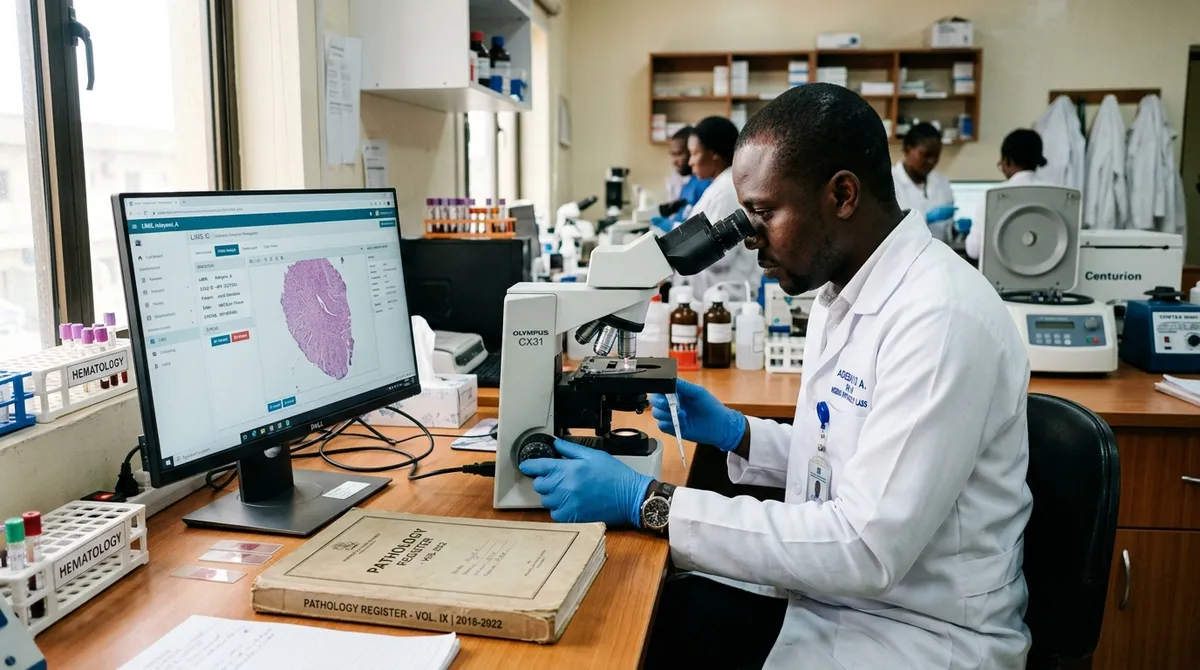
Let’s talk about that moment at the end of a long shift when you validate your last batch of results.
Most of us were trained to believe that career growth means mastering a newer analyzer, learning a trickier staining technique, or running a more complex PCR assay. We focus entirely on what happens between receiving the specimen and producing the numbers.
What if the most lucrative, resilient move you can make in your career right now has almost nothing to do with bench reagents—and everything to do with what happens to that data once it leaves your hands?
This isn’t Silicon Valley hype or some vague "future of work" webinar. It’s happening quietly right now in Nigerian diagnostic centres, teaching hospitals, and research hubs. Real money, real failures, and genuinely new job titles are being carved out.
Here is an unvarnished look at where our field is actually heading—and how to make sure you aren't left behind at the bench.
#1. The Death of the Counter Book
Let’s be honest about how most diagnostic centres in Nigeria still operate: thick, dog-eared hardcover counter books, carbon copies, and chaotic Excel spreadsheets cobbled together during shift handovers.
A scientist pens down a result at the bench. An administrative assistant types it into a desktop computer. Sometimes someone else retypes it downstream onto a printed slip. Every single handoff is an open invitation for a transcription error—and if you’ve ever had to hunt down a missing patient result at 7:00 PM, you know how broken that system is.
This is why modern labs are discarding paper overnight. Platforms like Consolish LIMS were engineered precisely for this reality. Instead of forcing a mid-sized diagnostic centre to cough up six- or seven-figure enterprise licensing fees (plus a dedicated server room nobody knows how to service), it’s a lightweight, cloud-based, multi-tenant system. Different labs run securely on the same dependable infrastructure through a standard browser, cutting out servers, spreadsheets, and manual re-entry entirely. Results hit the clinician’s phone the moment you sign off.
The career play: Software doesn’t deploy itself. Labs need people who understand both clinical workflow and digital systems—professionals who can audit data hygiene, configure reference intervals, customize reporting templates, and train frustrated staff. That bridge between medicine and software is quietly turning into one of the most stable specialist roles in the country.
#2. When Algorithms Start Scanning Slides
Let’s cut through the noise about AI taking our jobs. Across Africa, artificial intelligence isn't coming to replace lab scientists; it’s being dragged in out of pure necessity.
Our continent carries a disproportionate share of the global disease burden with a fraction of the diagnostic workforce. An estimated 47% of the world lacks adequate diagnostic access. A 2025 editorial in the African Journal of Laboratory Medicine highlighted where the needle is already moving: automated haematology differentials, molecular diagnostic triage, and digital microscopy. In histology, an automated scan can shrink a biopsy turnaround time from several agonizing days to a matter of minutes.
We don’t have to look abroad for proof. Look at the telepathology collaboration between Jos University Teaching Hospital (JUTH) and Lagos University Teaching Hospital (LUTH). Using a portable digital slide scanner, teams have digitized and remotely reviewed over 200 cervical cancer cases. No couriers. No broken glass slides stuck in transit on interstate highways. Just high-resolution digital imaging shared across state lines for instant peer review.
The takeaway? The scientist who knows how to prepare an immaculate slide, run a digital whole-slide scanner, calibrate image quality, and annotate tissue morphology digitally is suddenly in a completely different earning and demand bracket than someone who only knows how to adjust the coarse knob on a manual Olympus scope.
#3. The 54gene Reality Check
We can’t discuss tech and laboratory medicine in Nigeria without addressing the elephant in the room: 54gene. When they launched in Lagos back in 2019, it felt like our collective arrival on the global stage. They raised roughly $45 million, built Nigeria’s first state-of-the-art private biobank with over 200,000 African samples, and tackled a critical blind spot—less than 3% of genetic data used in global research came from African populations.
And then the cracks showed. Three CEOs rotated through in a single year, burn rates outpaced revenue, and by 2023 the company was in liquidation, leaving assets tied up in high-profile Nigerian court battles.
The lesson here is not that genomics is a dead end. Far from it. The lesson is that biotechnology ventures are brutally capital-intensive and unforgiving. Having noble science isn’t enough if the corporate governance and operational realities fail.
If you want to pivot toward genomics and molecular diagnostics, don't just fall in love with the mission statement. Look for financial discipline, learn data governance, and understand how the business side of diagnostics actually breathes.
#4. The Wild West of Regulation
At the 2026 AMLSN Lagos State Branch conference, the mood wasn't just celebratory—it was deeply cautious.
Here’s the reality: Nigeria imports anywhere between 95% and 99% of its in-vitro diagnostic products. At the same time, we have a massive regulatory void regarding tele-laboratory networks, algorithmic diagnostic tools, and cross-border digital patient data. Nigeria still lacks a unified, fully enforced digital health framework.
That regulatory vacuum is frustrating, but it also creates massive career leverage.
The people who will write the standard operating procedures, sit on regulatory evaluation panels, and establish digital quality control frameworks won’t be pure software engineers—they will be Medical Laboratory Scientists who took the time to understand medical device law, digital ethics, and data compliance.
#5. Why "Japa" Isn't the Only Strategy on the Table
We all felt the shockwaves between 2021 and 2022, when an eye-watering 90% of all MLSCN-recorded emigrations over a five-year window happened in just 24 months. Almost every lab in the country lost an experienced hand to the UK, Canada, or the Middle East. It’s hard to blame anyone who walked out the door.
What’s interesting, though, is the pushback happening on a policy level. In the federal government's 2024 National Policy on Health Workforce Migration, one of the core pillars specifically targets digital health and technology as a retention mechanism.
Telepathology networks, decentralized clinical trials, and remote LIMS administration mean you no longer have to board an overnight flight to Heathrow to tap into modern, well-compensated diagnostic workflows. Global remote work has arrived in clinical diagnostics.
#6. Where the Real Jobs Sit Right Now
If you are ready to expand your footprint beyond routine bench testing, stop waiting for someone to hand you a new job description. Start building competence in these specific niches:
- LIMS Implementation & Health Informatics: Help facilities transition from pen-and-paper to platforms like Consolish LIMS. Learn system setup, workflow mapping, and staff onboarding.
- Digital Pathology & Tele-Imaging: Master whole-slide scanning, digital quality assurance, and image annotation for remote diagnostic networks.
- Disease Surveillance & AMR Data Cleaning: Global health bodies constantly flag gaps in Nigeria’s Antimicrobial Resistance (AMR) reporting. Scientists who can turn messy paper registers into clean, epidemiologically sound digital datasets are invaluable.
- Diagnostic Compliance & Validation: With AMLSN calling for stricter oversight on point-of-care and imported digital testing tools, quality officers with digital literacy are commanding serious respect.
- Bioinformatics & Molecular Data Management: Yes, the science is valid—just make sure you inspect the operational foundation of whoever is signing your paycheck.
#The Bottom Line
The test tube and the microscope aren’t disappearing. But they are no longer the ceiling of what a medical laboratory scientist can do.
The future belongs to the scientists who refuse to be just sample processors—the ones who decide to become the architects of how diagnostic data is gathered, protected, and used. That pivot starts the moment you step back from the bench and look at the bigger picture.
11:10 PM